
Expected Benefits
- Claims of operating savings.
- Claims that consolidation would stabilize finances.
- Claims that students and funding would remain in the public system.
- Transportation assumptions that required accurate forecasting.
Rural Schools. Real Stakes.
Years of Uncertainty. Generations of Success.
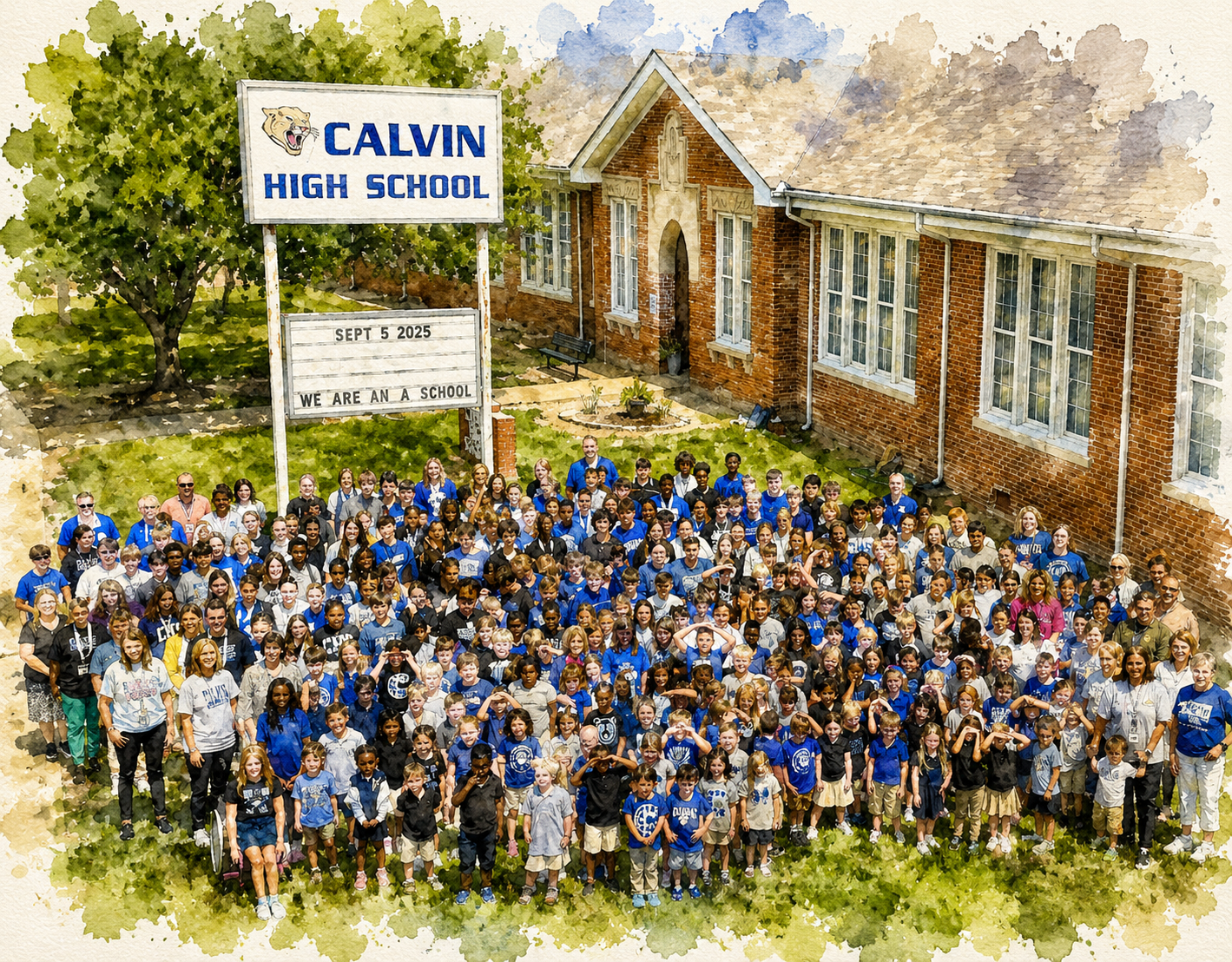
For years, Calvin High School and other rural schools have faced recurring discussions, studies, proposals, rumors, and concerns regarding consolidation or closure. This uncertainty affects students, families, teachers, staff, and the broader Winn Parish community.
The future of Calvin has never been defined by a building. It has always been defined by its students, families, teachers, alumni, churches, and community.
If Calvin High School were closed, the Calvin community would not simply disappear. The same people who built a tradition of academic excellence, athletic success, leadership, and community involvement would continue seeking ways to preserve those opportunities for future generations.
History shows that when families lose access to a school they value, many pursue alternatives. Those alternatives may include homeschooling, private schools, faith-based schools, charter schools, neighboring school districts, or other community-led educational options.
The greatest risk is not that Calvin would cease to exist. The greatest risk is that Winn Parish Schools could lose students, families, community support, and the state funding that follows those students.
Closing Calvin High School will not reverse the long-term enrollment decline facing Winnfield schools. Nor will it automatically solve the financial, administrative, contracting, or operational challenges facing the district. In fact, if families choose alternative educational options, it could accelerate student losses, reduce state funding, and deepen the financial pressures already facing Winn Parish Schools.
The tradition of Calvin is built on people, not walls. That tradition will continue. The question facing Winn Parish is whether those students, families, and future opportunities will remain part of the public school system or grow elsewhere through private, charter, faith-based, homeschool, or other community-led educational opportunities.
Strong schools are built by strong communities. The strength of Calvin has always been its people, and that strength will continue regardless of the challenges it faces.
Proven Strengths
For decades, education has been filled with trends, theories, mandates, and "next big solutions" that promised to transform schools. Many arrived with great enthusiasm, consumed enormous amounts of time and money, and then quietly faded away when results failed to match expectations.
Educators have seen wave after wave of reforms promoted as solutions to challenges facing public education.
Some provided benefits. Others produced unintended consequences. Few delivered the dramatic results that were promised.
Calvin High School has spent more than a century building that foundation.
Its success was not created by a government initiative, a consultant's report, or the latest educational trend. It was built through generations of students, teachers, parents, administrators, churches, businesses, alumni, and community members working together to create a culture of excellence.
The question facing Winn Parish is simple: should a proven school with a long record of academic achievement, athletic success, community support, and student opportunity be disrupted in an attempt to solve problems that originated elsewhere?
Closing or consolidating a successful school does not automatically improve another school's enrollment, culture, academic performance, or financial condition. Look at the facts: Winnfield is drastically losing MFP money from falling enrollment numbers, while Calvin has maintained its enrollment numbers for decades.
History teaches an important lesson: when something is working, it should be strengthened, not dismantled. Before abandoning more than 100 years of educational excellence, Winn Parish should ask whether the solution is to break what works or to learn from it.
Strong schools are not the problem. Strong schools are part of the solution.History and Context
For years, rural school families have heard closure and consolidation discussed as a way to address falling Winnfield enrollment and Winn Parish School Board financial problems. The abrupt 2023 closure of Atlanta High School showed what happens when a rural community becomes the test case without clear research, accurate forecasting, or a public post-mortem explaining whether the promised fixes actually worked.
| Year | Event | Outcome |
|---|---|---|
| Years leading to 2023 | Public discussions presented rural school closure as a proposed response to falling Winnfield enrollment and Winn Parish School Board financial pressures. Atlanta enrollment was weak, but closing Atlanta High School did not solve the goals that were promised. | The rapid closure process disrupted parish cohesion and continues to fuel public concern about transparency, planning, and trust. |
| 2023 | Atlanta High School was closed quickly and abruptly. | The closure became a real-life test of whether consolidation could solve enrollment, funding, and transportation problems in Winnfield. |
| After 2023 | Enrollment, MFP revenue, and transportation pressures remained serious concerns after the closure. | No credible public post-mortem, accurate financial model, or documented result has proven that the Atlanta closure fixed the enrollment, funding, transportation, or trust problems it was supposed to solve. |
| 2024 | Calvin faced renewed closure discussions without a clear public showing that closing a high-performing, stable-enrollment school would solve district problems. | The proposal raised serious questions about whether closure would improve finances, enrollment, or student outcomes. |
| 2025 | Bond measures passed in the Calvin and Dodson districts to support their school campuses. | Local voters showed direct support for maintaining and investing in rural school campuses. |
| 2025 | New Superintendent Dr. Troy Bell stated publicly during the superintendent process and in public comments that he supports rural schools and had no intention of closing rural schools. | Those comments should now be measured against actions. The public will see whether Dr. Bell stands by those commitments when rural schools face pressure or closure discussions. |
| 2026 | As Winnfield Senior High School enrollment continues to fall, Calvin again faced public consolidation concerns tied to discussion of a 23 million dollar bond, about 40 million with interest, in the Winnfield School District. | Questions remain about central office costs, outsourcing, enrollment trends, and whether stable rural schools should be treated as leverage in a broader financial problem. |
Case Study
What Happens When Enrollment Leaves Faster Than Expenses?
The Atlanta closure should be examined as a warning before any further rural consolidation is considered. If closures are promoted as a solution to enrollment decline and financial pressure, the public deserves clear financial models, accurate forecasts, and an honest review of what happened after Atlanta High School closed.
The closure of Atlanta High School was presented as a strategy to improve the financial condition of the Winn Parish School System. Instead, it exposed how dangerous it is to close a rural school without accurate research, dependable forecasting, and a public plan for measuring success or failure.
The lesson is larger than Atlanta: further consolidation of rural schools could trigger a financial death spiral if families leave the public system, transportation costs rise, MFP funding falls, and new private or charter alternatives grow in response to lost local schools.
Source: Louisiana Legislative Auditor (LLA) Audited Financial Reports for Winn Parish School Board. Full reports available at:
Search "Winn Parish School Board" in the public reports search.
Closing a school does not eliminate transportation costs. Students still must be transported to classrooms each day. When students are reassigned to schools farther from their communities, transportation routes become longer and more expensive.
Although transportation expenditures declined slightly after the transition year, they remained substantially above pre-closure levels. Revised accounting methods and transportation-cost calculations do not erase the consecutive-year increases in transportation costs.
Enrollment Drives Funding
MFP funding follows students. When enrollment falls, state funding falls with it. Calvin and Dodson have maintained stable enrollment for decades, helping keep students and funding inside the public school system.
Falling enrollment directly reduces the student count that drives parish MFP funding.
Stable enrollment helps protect the MFP funding attached to students who remain in Winn Parish public schools.
Stable enrollment helps protect the MFP funding attached to students who remain in Winn Parish public schools.
Winn Parish MFP revenue fell from $14.78 million in FY 2023 to $12.72 million in FY 2025.
Louisiana's Minimum Foundation Program (MFP) funding is driven by student enrollment. Despite the closure of Atlanta High School, MFP revenue continued to decline in subsequent years.
When a community school closes, some families look for private, charter, homeschool, virtual, or out-of-parish options. After Atlanta High School closed, a new private school was formed in Atlanta, worsening enrollment loss and reducing MFP dollars for Winn Parish public schools.
Further rural school consolidation risks worsening the very enrollment and financial problems it claims to solve.
Students must travel farther to attend school.
Fuel, maintenance, labor, and routing expenses increase.
Transportation systems often require additional buses and vehicle leases.
Transportation costs may remain elevated long after consolidation occurs.
Schools are more than educational facilities. They are anchors of their communities.
When a school closes, families lose a local institution, businesses lose activity, communities lose gathering places, and future growth becomes more difficult.
Many communities across Louisiana have experienced population decline after losing important public institutions.
Before considering the closure of another successful rural school, Winn Parish should carefully evaluate whether the anticipated savings would outweigh the potential risks.
Current Record
Current state performance data demonstrates that Calvin remains the highest-performing school in Winn Parish.
Atlanta High School was a valued part of its community, just as Calvin High School is today. Any future decision should honor Atlanta's legacy and apply the lessons learned from its closure.
Calvin is a high-performing Pre-K through 12 school with strong academic results, athletic achievements, community support, and stable enrollment compared to broader parish trends.
Any discussion regarding the future of Calvin should consider not only lack of true cost savings, but also the impacts on enrollment retention, transportation costs, educational choice, state funding, and community stability.
"The lesson of Atlanta is not whether a school could be closed. The lesson is whether the closure achieved its intended goals and whether repeating the same strategy would produce a different outcome."
Potential Consequences
Student migration to neighboring districts
Increased homeschooling
Private school enrollment growth
Charter school development
Longer transportation routes
Higher transportation costs
Reduced community engagement
Loss of educational choice
"When families lose educational options, some seek alternatives outside the local public school system. Retaining successful schools helps retain students, families, and funding within Winn Parish."
Enrollment and Demographics
Enrollment trends help show whether a school is losing students, holding steady, or serving as a stable rural option while broader parish demographics shift.
Grades 9-12 enrollment has declined from an estimated peak near 545 to 328 in 2026.
Pre-K through 12 enrollment has remained stable across the same comparison years used for Winnfield.
Pre-K through 12 enrollment has remained stable across the same comparison years used for Winnfield.
Calvin High School has not suffered the kind of enrollment collapse seen elsewhere. It has maintained stable enrollment numbers for decades, even while past enrollment policies may have limited Calvin's ability to grow by restricting outside student enrollment. Neighboring Jackson Parish provides a compelling example of a different approach: rural schools were allowed to grow and now outperform city-center schools in enrollment. This suggests that strong rural schools can be an asset for retaining families, strengthening public education, and keeping students in the parish system.
Regional Case Study
A neighboring example of rural school growth and student retention.
Jackson Parish provides a useful example of how rural schools can thrive when they are supported and allowed to grow.
Rather than concentrating enrollment into a single city-centered campus, Jackson Parish maintained and invested in its rural schools. In the 2023–2024 NCES data, Quitman and Weston together served the majority of students enrolled across Jackson Parish public schools, even when all three Jonesboro-Hodge city campuses are counted.
The 2023–2024 NCES district listing shows approximately 737 students at Quitman and 632 at Weston, for a combined rural-campus enrollment of 1,369. For an equivalent PK–12 city comparison, Jonesboro-Hodge Elementary enrolled 332 students, Jonesboro-Hodge Middle enrolled 155, and Jonesboro-Hodge High enrolled 222—a combined city-campus enrollment of 709.
Together, these five schools enrolled approximately 2,078 students. Quitman and Weston accounted for about 65.9% of that total, compared with about 34.1% across the three Jonesboro-Hodge campuses.
This demonstrates that rural schools do not have to decline. When families are given educational choices and successful schools are allowed to grow, rural campuses can become the primary educational centers of their communities.
Enrollment Comparison
City total: Jonesboro-Hodge Elementary (332) + Middle (155) + High (222) = 709. Rural total: Quitman (737) + Weston (632) = 1,369. Figures reflect NCES 2023–2024 public school records.
Rural schools are not automatically destined to shrink, as Calvin and Dodson have already proven through decades of stable enrollment. Jackson Parish demonstrates that when strong rural schools are supported, they can attract and retain families, maintain enrollment, provide educational choice, and become the largest schools in the parish.
What This Means for Calvin
Calvin High School has demonstrated strong academic performance, athletic success, student engagement, community support, and decades of stable enrollment. Calvin has not dropped enrollment in the way critics of rural schools often suggest.
Like successful rural schools in neighboring parishes, Calvin has the potential to attract and retain even more students if given the opportunity to grow. In the past, School Board limits on outside student enrollment prevented Calvin from fully demonstrating that growth potential.
The experience of Jackson Parish suggests that supporting successful rural schools can strengthen enrollment, preserve educational choice, and help families remain within the public school system.
Sources:
Questions for the Future
How can Winn Parish retain more students?
How can successful schools be strengthened?
What are the long-term financial impacts of consolidation?
How can educational choice benefit families?
What lessons can be learned from past decisions?
How can rural communities remain strong?
The future of Winn Parish education should be guided by facts, performance, financial responsibility, student outcomes, and community needs. Understanding the lessons of the past can help ensure the best decisions are made for future generations.